She Sells Seashells (2026): A 23-Minute iPhone Drama That Finds Freedom in Fleeting Frames

The opening frames of “She Sells Seashells” find Maruti on a Goa beach, her hands arranging trinkets for tourists who barely see her. It’s a quiet start, but director Ritesh Sharma’s camera refuses to look away from her face, and that choice becomes the film’s quiet engine.
Maruti, a Gormati migrant, has learned English from the very tourists she sells to, and that adaptability is her armor. The film understands that survival for someone like her isn’t loud; it’s in the small calibrations of tone and posture.
Maruti’s Performance Is Built on Observation, Not Declaration
The lead actor anchors the film in restraint. There’s no grand monologue announcing her plight, instead, her performance lives in the way she watches the restaurant patrons she’ll never join, in the flicker of recognition when she hears English spoken casually around her.
During the dreamlike passages, the role shifts to facial expressiveness, and the actor holds those moments without tipping into melodrama. It’s a portrait of a woman who has learned to perform for others, and is just beginning to realize she’s performing for herself.
The phone call from her mother changes everything. In-laws are arriving in two days to take her away, and the news lands on Maruti’s face like a physical blow, the film’s best-acted moment, precisely because it’s underplayed.
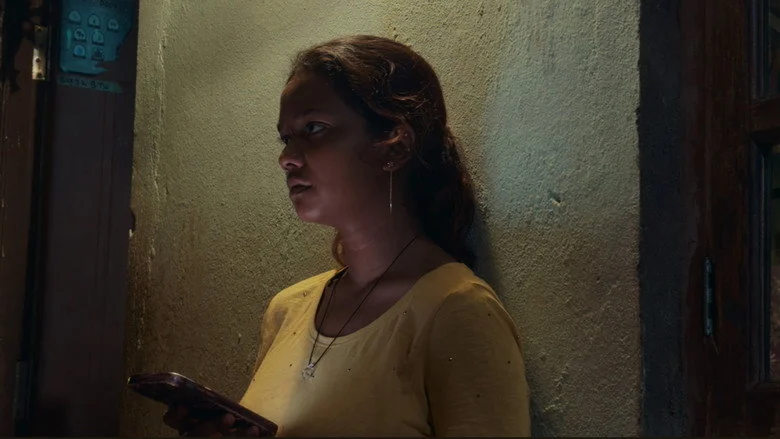
The iPhone Craft Turns Limitation Into Intimacy
Sharma’s decision to shoot on an iPhone 17 Pro Max isn’t a gimmick, it’s the film’s identity. The handheld immediacy gives the beach a tactile quality, and the cinematic mode’s focus shifts between Maruti’s reality and her inner world create a visual grammar of longing. The dreamlike sequences are where the film finds its voice, using shallow focus to blur the line between what she has and what she imagines.
But the 23-minute runtime cuts both ways. The film establishes its world with admirable economy, yet the cultural and social context, the weight of Gormati migrant life, the specific pressures of family obligation, remains frustratingly underdeveloped. The middle section feels compressed, as if the screenplay is reaching for a depth the format can’t quite hold.
There’s also a romanticism that threatens to soften the material’s harder edges. The beach setting and lyrical inserts risk prettifying a story that deserves more grit. Sharma’s direction is confident, but the brevity forces a lean storytelling that occasionally feels more like an outline than a fully realized drama.

The Stranger and the Off-Screen Pressure
The compassionate stranger functions less as a character than as a catalyst, an empathetic presence who pushes Maruti toward confronting the gap between her imagined freedom and her actual circumstance. The role is thinly sketched in the sources, but its casting signals the film’s intent: this is a story about empathy as a destabilizing force, not a rescue narrative.
The mother’s off-screen presence carries the film’s structural weight. Her phone call is the turning point that drags Maruti back from fantasy to obligation, and the in-laws remain an invisible pressure, which is precisely the point. The enemy here isn’t a villain; it’s a social system that treats Maruti’s desires as irrelevant.
What This Short Says About the Long Game
The film’s lack of controversies is telling, it’s not interested in provocation but in intimacy. Its target audience is clear: viewers who want their drama small, their characters specific, and their politics implied rather than announced.
For a film shot on a phone and premiered through MAMI Select, the ambition is modest but genuine. The visual subjectivity is the real achievement, placing us inside Maruti’s head without ever leaving her side. I found myself wishing the film had another ten minutes to breathe, to let the social world press harder against her dreams.
What remains is a tightly centered emotional arc that knows exactly what it wants to say and says it in 23 minutes. For a short-form drama, that’s a respectable bargain, even if the cultural texture feels like a sketch waiting for a fuller canvas. If you’re curious about how mobile filmmaking can serve character-driven storytelling, this is worth a stream. Browse more Hindi drama reviews for similar intimate portraits.
For those who want a complete narrative with developed social stakes, “She Sells Seashells” will feel like a fragment. But for viewers drawn to migrant stories and subjective visual storytelling, it’s a sharp, fleeting glimpse of a life that deserves more screen time. Watch it on OTT, where the intimate framing works best.
“She Sells Seashells” is a promising fragment rather than a finished statement, a 3/5 experiment that proves the iPhone can capture interiority, even if it can’t yet capture the full weight of the world around it.
For a different take on romantic nostalgia, see how Hai Jawani review handles similar themes of aspiration and constraint.
If you prefer your social commentary with sharper teeth, Dharpakad verdict offers a more urgent, thriller-driven approach to contemporary anxieties.
She Sells Seashells (2026): A 23-Minute iPhone Drama That Finds Freedom in Fleeting Frames
Visually captivating cinematography, stellar sound design, and commanding performances.
Slight pacing drag in the second act before the climactic resolution.