Indian Institute of Zombies (2026): A Brain-Dead Campus Comedy That Lacks Bite
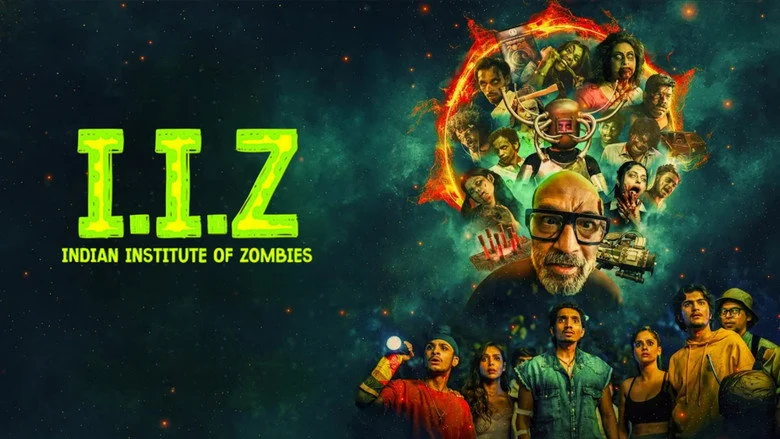
The immortality experiment goes catastrophically wrong in the first act of Indian Institute of Zombies, turning an elite engineering campus into a flesh-hungry battleground where academic robes meet gore-soaked corridors. It is a premise with genuine satirical teeth, privilege, competition, and institutional pressure weaponised into a zombie outbreak, but the execution fumbles the promise within minutes.
The Premise Is Sharp, But the Script Has No Scalpel
Directors Alok Kumar Dwivedi and Gaganjeet Singh identify a workable hook: what happens when the relentless pursuit of academic immortality literally unleashes the undead? The satire target is clear, and the campus hierarchy, with Mohan Kapur’s dean presiding over the chaos, gives the film its strongest structural anchor.
Yet the screenplay, credited to five writers including Kunj Sanghvi and Hussain Dalal, never builds on that foundation. The writing is described as weak, random, and incoherent in multiple reviews, with forced humour interrupting every attempt at tension.
Mohan Kapur Anchors Authority, But the Film Ignores Him
Kapur’s dean is positioned as the formal authority figure around which the campus order collapses. His performance is tied to institutional control and outbreak response rather than spectacle, which suits his controlled register, but the script gives him little to work with beyond bureaucratic reaction.
Anupriya Goenka’s university professor sits close to the institutional core as well, but neither actor receives scene-specific analysis in available reviews. Their casting signals intent: the film wants credible authority figures to ground its chaos, yet the writing fails to reward their presence with meaningful arcs.
Horror-Comedy Balance: A Tonal Tug-of-War That Nobody Wins
The horror elements rely on a familiar zombie-outbreak setup, and the campus setting provides a genuinely fresh geography for undead mayhem. Classroom spaces and academic corridors become survival zones, which is the film’s most distinctive visual idea.
But the comedy is driven by pop-culture one-liners and random references rather than situational escalation. “Kiris ka gaana sunega?” lands as a shrug, not a laugh, and critics have specifically flagged these interruptions as momentum-killers that dilute whatever dread the setpieces manage to build.
The satire of institutional privilege remains legible throughout, but it never sharpens into a coherent thesis. The film knows what it wants to mock, academic competition, student hierarchy, the absurdity of elite education, yet it keeps undercutting its own observations with juvenile gags and tonal whiplash.
Second Half Improves, But the Damage Is Done
Several reviewers note that the second half is more watchable than the first, which is damning with faint praise. The editing tightens marginally, and the survival dynamics among the student cast, Ranjan Raj, Shivani Paliwal, Shantanu Anam among them, gain slight traction.
But the narrative remains scattered, and the climax offers resolution without payoff. The Times of India’s 1.5/5 rating captures the consensus: a potentially fun comedy lost in weak writing. Another critic called it “a brain-dead zombie comedy that eats away your patience, ” and the BookMyShow audience score of 4.9/10 from 95+ votes suggests viewers agree.
Trade coverage has already declared the film a flop, describing it as too random to make any box office impact. The absence of face value, no marquee star, no established franchise, left it with no commercial cushion.
For more campus-set genre experiments, browse Hindi Horror reviews.
What the Film Gets Right, Briefly
To its credit, Indian Institute of Zombies places its outbreak inside an academic elite setting rather than a generic urban backdrop, which is more than most mainstream zombie comedies attempt. The satire of campus hierarchy is explicit, and the premise itself, students battling the undead while navigating institutional absurdity, has genuine genre ambition.
That ambition is recognised even by negative reviews, which is a small mercy. But a good concept is not a good film, and this one never translates its hook into sustained comedy or credible horror.
I found myself wishing the writers had trusted their premise more and their reference bank less.
Verdict: Skip the Theatre, Wait for a Bored Afternoon
If you are a completist for Indian zombie comedies or a fan of the cast, this is a one-time watch at best, and even then, only on a streaming platform with a remote nearby. The premise deserves better, and the actors deserve sharper material, but the final product is a scattered, tonally confused exercise in missed potential.
Indian Institute of Zombies is a flop that earns its fate, 1.5 out of 5, and even that feels generous on a second viewing.
For a sharper take on institutional satire, check Dug Dug review.
If you prefer confined performance dramas, I m verdict offers a stronger test of craft.
Indian Institute of Zombies (2026): A Brain-Dead Campus Comedy That Lacks Bite
Visually captivating cinematography, stellar sound design, and commanding performances.
Slight pacing drag in the second act before the climactic resolution.