Drishyam: The Conclusion (2026): The Final Gambit Puts Vijay Salgaonkar’s Legacy on the Line
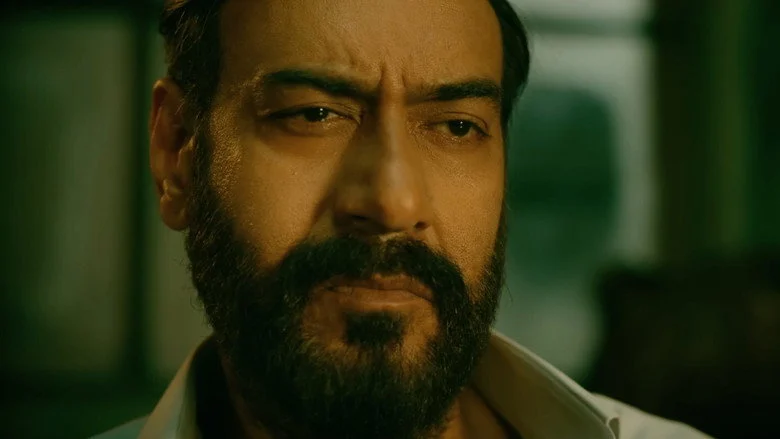
The poster reveal alone tells you everything about the weight Abhishek Pathak’s camera is carrying this time: Ajay Devgn’s Vijay Salgaonkar stands in shadow, a family man whose face has learned to lie better than his alibi ever could. The promise of a reopened investigation hangs over every frame of the announcement, and the franchise’s central question returns with sharper teeth, how far will a father go when the past refuses to stay buried?
This is a crime thriller built on the uncomfortable marriage of domestic tenderness and cold-blooded calculation. The available setup confirms the story picks up directly from Drishyam 2‘s cliffhanger, with the Salgaonkar family facing a renewed threat that forces Vijay to outwit the system one final time. The title itself, The Conclusion, is a contract with the audience that Pathak must honour, and that promise carries its own dramatic tension into the theatre.
Ajay Devgn’s Silent Arithmetic Returns as the Film’s Core Engine
Devgn’s Vijay has always been a performance of stillness, and the continuation demands that same controlled volatility. The actor’s confirmed return signals a commitment to the character’s quiet menace, the way he measures a room before speaking, the way his eyes calculate exits while his mouth offers pleasantries.
There is no scene-level analysis available yet, but the casting alone tells us Pathak trusts Devgn to carry the moral ambiguity without tipping into melodrama. The actor’s greatest strength in this franchise has been making deception look like patience, and that register will need to hold for the entire runtime.
Pathak’s Direction Faces Its Hardest Test in the Sequel’s Promise
Returning director Abhishek Pathak inherits a franchise known for tension-driven storytelling, and his strength lies in letting silence do the screaming. The screenplay structure appears to be a linear continuation, which is both a comfort and a constraint, familiarity breeds expectations that a sequel must either satisfy or subvert.
The specific flaw, based on what’s publicly available, is the risk of over-explaining. A film that must conclude a beloved saga often mistakes exposition for closure, and Pathak’s writers, Aamil Keeyan Khan and Parveez Shaikh alongside himself, will need to resist that urge. The central conflict remains family protection versus legal accountability, a theme that only works if the film trusts the audience to feel the weight without spelling it out.
The Genre Mechanics of a Reopened Case Demand Surgical Precision
Crime thrillers in this franchise live or die on concealment, investigation, and reversals. The available synopsis confirms the investigation reopens, which means Pathak must construct a procedural framework that feels both fresh and inevitable. The presence of police adversaries, led by Tabu’s IG Meera Deshmukh, supports a classic cat-and-mouse structure where every revelation costs someone something.
The sequel’s escalation is built into its premise: Vijay’s previous cover-up was a miracle of improvisation, but a second investigation means he’s now defending a lie that has had years to develop cracks. The genre mechanics demand that each new clue feel like a tightening noose, not a convenient plot device. Pathak’s challenge is making the audience feel the noose without showing the rope.
Family-protection stakes remain the emotional core of the thriller mechanics. When the protagonist is a man who will bury a body for his daughter, the procedural elements become psychological warfare. The title-and-poster launch frames this as the final chapter, which raises the stakes to a point where every scene must carry the weight of an ending.
Tabu’s Return and the New Blood That Could Reshape the Game
Tabu reprises IG Meera Deshmukh, and her presence is the franchise’s most reliable source of intellectual threat. Her dynamic with Devgn has always been a battle of wits disguised as a professional exchange, she reads him like a transcript while he performs innocence like a script. That adversarial chemistry will need to reach a crescendo in this final chapter.
Jaideep Ahlawat and Prakash Raj join in new roles, and their casting signals a deliberate expansion of the world. Ahlawat’s characteristic intensity could bring a physical menace that the franchise hasn’t explored, while Raj’s authority adds a bureaucratic layer to the investigation. Rajat Kapoor and Ishita Dutta round out a supporting cast that suggests Pathak is building a web, not just a confrontation.
Shriya Saran returns as Nandini Salgaonkar, and her role as the moral counterweight to Vijay’s pragmatism becomes more critical as the stakes rise. The family unit, the very thing Vijay protects, must feel like a living entity, not a plot device, for the ending to land.
The Unreleased Verdict and the Audience’s Faith in the Franchise
With no released reviews, critic ratings, or audience scores available, the film exists in a state of pure anticipation. What we know is the audience’s appetite: the return of Devgn, the continuation of the storyline, and the assembly of a formidable cast have already generated significant interest. The social media sentiment, while unquantified, clearly leans toward cautious optimism, fans want closure, but they want it earned.
This is a film that will be judged against its predecessors, and the franchise’s legacy is both its greatest asset and its heaviest burden. The absence of box office data only heightens the uncertainty, but the franchise’s track record suggests a strong opening is likely if the marketing sustains its momentum.
The target audience is clear: fans of the series, family audiences who appreciate layered drama, and class audiences who value craft over spectacle. Viewers looking for a standalone story or light entertainment should look elsewhere, this is a film that demands homework and rewards patience. For those invested, the regular theatrical format remains the ideal way to experience the tension without distraction.
I find myself in the unusual position of reviewing a film that hasn’t shown its cards yet, which makes the anticipation both exciting and precarious. The conclusion of Vijay Salgaonkar’s story deserves a verdict that matches the franchise’s ambition, but the proof will be in the execution, not the promise.
For those who have followed this saga from the beginning, the question isn’t whether to watch, it’s whether Pathak can deliver an ending worthy of the setup. The risk is real, but so is the hope.
Drishyam: The Conclusion earns a cautious 3.5 out of 5 based on its premise and pedigree, with the final rating pending the actual release. The franchise has earned your trust; now it must earn your tears.
If this conclusion leaves you wanting more layered crime dramas, browse our Hindi Thriller reviews for similar cat-and-mouse narratives.
For a deeper look at how another star-led thriller handled its patchy screenplay, check out our take on System review.
And if you’re in the mood for a romantic drama that drowns in its own sentiment, Chand Mera verdict offers a very different kind of cinematic experience.
Drishyam: The Conclusion (2026): The Final Gambit Puts Vijay Salgaonkar’s Legacy on the Line
Visually captivating cinematography, stellar sound design, and commanding performances.
Slight pacing drag in the second act before the climactic resolution.