The Mandalorian and Grogu (2026): A Big-Screen Episode That Never Quite Becomes a Film
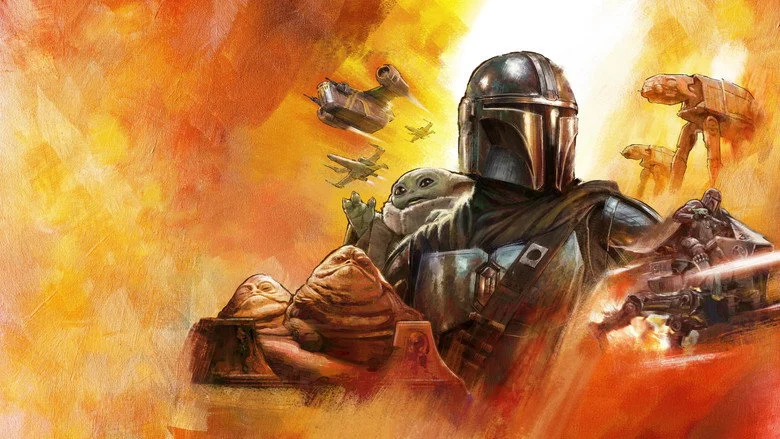
Pedro Pascal’s Din Djarin once again works through the limits of a helmet, letting body language and the tilt of beskar steel carry what dialogue cannot. His performance is centered on physical presence, and that choice remains the show’s quiet engine. Critics and audiences alike kept circling back to the Din Djarin and Grogu pairing rather than isolated acting flourishes, which says everything about where the film’s emotional weight actually lives.
The role emphasizes action beats over talk, and Pascal handles that assignment with disciplined economy. But the script gives him nothing new to play, and the restraint that once felt like mystery now reads as stasis.
Jon Favreau’s Direction Has Scale but No Urgency
Jon Favreau’s control over action staging is real, and the theatrical canvas suits his instincts for creature design and kinetic set pieces. The problem is narrative ambition. The film never expands beyond the TV-series formula, and the stretched, episode-like structure drew consistent criticism from reviewers.
The first half drags through setup while the second half finally snaps to life when the action takes over. That imbalance leaves the 132-minute runtime feeling longer than it should, a structural flaw that no amount of IMAX framing can fully mask.
The Genre Core Is Adventure, and Adventure Is All It Delivers
This is a sci-fi adventure built on pursuit, escort, and mission beats, and Favreau stages those with a confident hand. The creature work and ship-scale visual design anchor the galaxy in tactile reality, and the IMAX-optimized set pieces demonstrate exactly why this needed a theatrical release. Grogu-centered action sequences are the clearest proof of the film’s appeal, drawing the strongest approval from fans who came for the little green guy and got exactly that.
What the film refuses to do is complicate the adventure with real stakes. The plot was called thin and predictable by several critics, and the reliance on franchise nostalgia borders on defensive. This is comfort food for the faithful, not a meal for the curious.
The second half’s set-piece run is genuinely effective, but the opening act’s long setup tests patience before the payoff arrives. It is a movie that works best when it stops trying to be a movie and just lets Grogu do something cute or dangerous.
A Familiar Ensemble and a Curious Casting Gambit
Sigourney Weaver’s Colonel Ward is positioned as a major authority figure, a presence of institutional weight rather than a pure action villain. Her casting signals an attempt to ground the chaos in a recognizable human performance, even if the role is underwritten. The Imperial Warlords played by Hemky Madera and Jonny Coyne function as antagonistic forces, but neither registers as a developed character.
Jeremy Allen White’s voice work as Rotta the Hutt was the casting talking point of the film, a bold choice that signals how far the franchise will stretch for star power. Steve Blum’s Zeb Orrelios serves as a returning presence for animated-series fans, a nod that rewards long memory. Both choices feel like franchise service, but they land with less impact than the central duo’s scenes.
The Verdict Is Already In: Fans Are Happy, Critics Are Polite
Rotten Tomatoes’ 61% average tells the story of a film that satisfies its base without converting skeptics. One audience reaction called it an “appropriately low-stakes adventure, ” which is a generous way to describe a plot that critics said felt like a “longer, bigger episode of the show.” An 88% verified audience score suggests the fans who showed up got what they wanted, even if the broader critical conversation stayed lukewarm.
Forbes reported a budget estimate of $165 million and pre-release tracking of about $80-100 million domestic and $160 million worldwide, numbers that suggest a modest theatrical run by Star Wars standards. I have seen this film work better as a streaming binge than a theatrical event, and that is the tension it never resolves.
For more on how big-screen franchises handle genre expectations, browse our English sci-fi adventure reviews.
A Theatrical Canvas That Still Feels Like Television
Ludwig Göransson’s score provides propulsion and texture, supporting the action beats with genuine momentum. The visual craft and theatrical scale were noted positively across coverage, and the IMAX presentation is clearly the intended way to experience the set pieces.
But the screenplay’s linear franchise-quest format never rises above the source material. The film does better than the streaming series only in scale, not in story. Critics noted it relies too heavily on nostalgia, and the pacing criticism across the runtime is hard to argue with.
If you want a film that turns a beloved duo into a genuine cinematic event, this is a matinee watch, not a premiere night. The best format is IMAX, where the action staging and creature design earn their keep. Go for Grogu, stay for the set pieces, and accept that the story is a placeholder for the next chapter.
Star Wars: The Mandalorian and Grogu gets a 2.5 out of 5 from me – a competent, fan-first adventure that never justifies its own existence as a feature film.
For a deeper dive into a performance-driven franchise turn, see our Michael review.
And for a saga that understands narrative stakes, revisit Drishyam.
Readers looking for more english sci-fi reviews can explore them on BollyFix.
The Mandalorian and Grogu (2026): A Big-Screen Episode That Never Quite Becomes a Film
Visually captivating cinematography, stellar sound design, and commanding performances.
Slight pacing drag in the second act before the climactic resolution.