Magudam (2026): Vishal’s Ambitious Two-Headed Drama Stumbles Under Its Own Weight
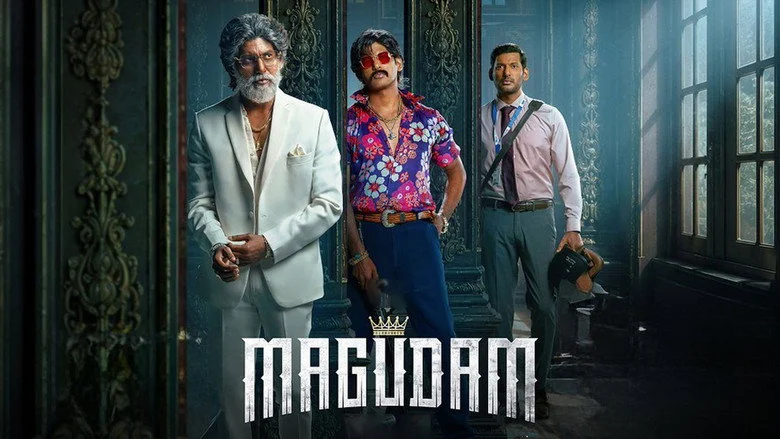
The opening sequence drops us into 1965 Visakhapatnam, where a boy named Linga claws his way out of a child trafficking racket. It is urgent, grim, and promises a certain kind of muscular storytelling.
What follows is a 185-minute attempt to connect that boy’s violent legacy to Kirubakaran, a middle-class family man played by Vishal, who is trying to keep his ordinary life intact. The ambition is visible from the first frame, but the execution never quite matches it.
Vishal’s Dual-Role Commitment Is the Film’s Only Consistent Pulse
Vishal carries the weight of two distinct personalities, and the contrast between the meek Kirubakaran and the feared Linga gives the film its most watchable moments. The action-driven sequences, especially the ones emphasizing that split, were singled out as the clearest showcase of his physical commitment.
He is far more convincing as the subdued family man than as the feared gangster, yet his effort keeps the enterprise from collapsing entirely. The performance is committed, but the material around him keeps pulling in too many directions at once.

The Screenplay’s Non-Linear Structure Betrays Its Own Premise
Director Vishal, stepping behind the camera for the first time, attempts to merge family drama with gangster action through a non-linear timeline that shifts between 1965 and the present. The coastal shipping-and-cargo backdrop is a genuinely distinct choice, giving the harbor confrontations a geography that generic city action often lacks.
The problem is control. Critics have noted that the film struggles with a screenplay that cannot always hold its multi-layered structure together, and the overreliance on exposition becomes exhausting by the second hour. The reveal-driven portions that alternate between Kirubakaran’s ordinary life and Linga’s criminal past feel less like narrative strategy and more like damage control.
The Indian Express gave the film a 2.0 rating, and one review described it as “a crown too heavy for weak storytelling.” Another critic wrote that “Magudam ends up being a heavy crown on a shaky head, ” which captures the central failure of the enterprise.
The Harbor Confrontations Deliver Scale But Not Tension
The action set-pieces are built for broad commercial scale, with gang control of the harbor world serving as the primary engine of conflict. The scenes where Kirubakaran is forced into direct confrontation with the forces tied to Linga’s legacy are staged with enough ambition to register visually.
Yet the threat works mainly through gang pressure and legacy conflict rather than through a sharply individualized antagonist. John Vijay appears as a supporting antagonist figure, but the criminal network never crystallizes into a memorable presence.
The most criticized stretches are the long, overextended portions where the screenplay pauses for exposition and timeline management instead of advancing the core conflict. The second half drags, losing narrative momentum precisely when the story should be tightening its grip.
Anjali Anchors the Domestic Strand While Dushara Vijayan Supports the Emotional Core
Anjali is positioned firmly in the family strand, grounding the domestic stakes that Kirubakaran is trying to protect. Her presence gives the film a necessary anchor, even if the available material does not confirm a fully realized character arc for her.
Dushara Vijayan supports the narrative’s emotional and conflict-driven portions, though her role remains underdeveloped in the larger scheme. V. Jayaprakash, Ajay, and Vamsi Krishna fill out the supporting cast, but none of them manage to leave a distinct imprint on the proceedings.
A Political-Launch Ambition That Sits Uneasily With Mass Entertainment
The film was seen as caught between mass entertainment and a political-launch style narrative without fully succeeding at either. The core theme of inherited violence disrupting ordinary family life is a strong hook, but the execution buries it under excessive runtime and uneven pacing.
Opening day collections stood at just ₹0.68 crore in India, as reported by Cinema Express citing Sacnilk, and the film was described as ending its opening weekend on a low note. Trade coverage has already labeled it a flop, which feels consistent with a product that could not translate its ambition into audience traction.
For a debut feature, the scale is genuinely ambitious, but ambition without control produces exactly this kind of overstuffed result. The father-son legacy hook and the coastal setting are refreshing choices that deserve a tighter, more disciplined screenplay.
Browse more Tamil action reviews to see how other films handle similar dual-timeline structures.
The film’s premise promises a layered gangster drama, but the result is a sprawling, uneven affair that never quite justifies its own length. If you are a Vishal loyalist, there is enough commitment in his dual-role performance to warrant a patient watch, preferably at home where you can pause the exposition-heavy stretches.
Magudam is a film that tries to wear a crown far too heavy for its storytelling, and I cannot recommend it in theaters. A generous 2 out of 5 for the effort, but the execution does not earn more.
For a tighter take on inherited violence, see how Hi review its narrative economy.
Vishal’s brooding presence works better in Awarapan 2 verdict than in this overstuffed drama.
Magudam (2026): Vishal’s Ambitious Two-Headed Drama Stumbles Under Its Own Weight
Visually captivating cinematography, stellar sound design, and commanding performances.
Slight pacing drag in the second act before the climactic resolution.