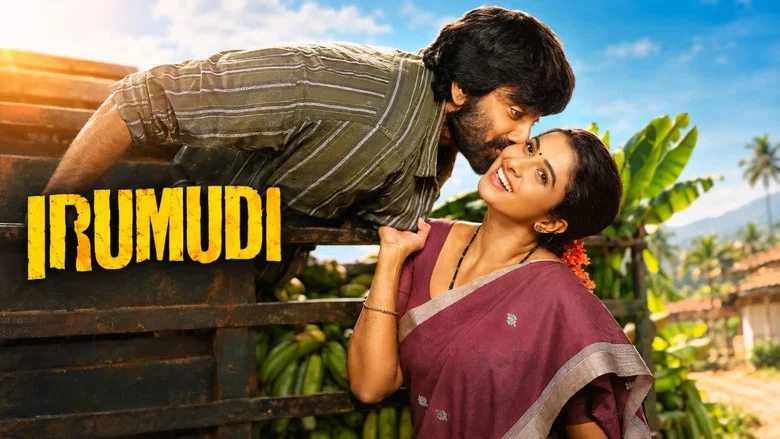
Irumudi (2026): Ravi Teja Anchors a Father-Daughter Drama That Loses Its Nerve
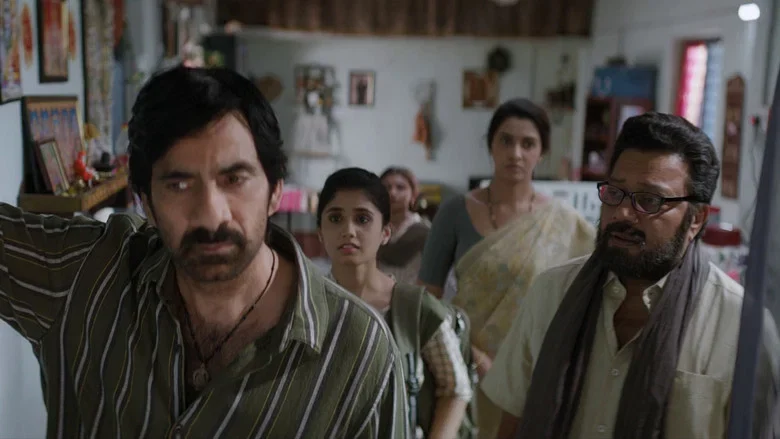
Ravi Teja spends the first hour of Irumudi doing something he hasn’t done in years: acting quietly. Then the film remembers it needs a conspiracy, and the floor gives way.
A Drunk Devotee Is a Better Character Than a Righteous Avenger
The film opens in Sileru with Trinadh Rama Kasu, auto-rickshaw driver and habitual drinker, walking his daughter Manikanta to the bus. Their ritual is specific and unsentimental: he tells her to report everything that happens in her day, no matter how small.
That instruction is the screenplay’s single smartest piece of engineering, planted early and detonated late. It also defines Trinadh as a father who is anxious rather than heroic, a man who has already guessed that the world outside his home is dangerous.
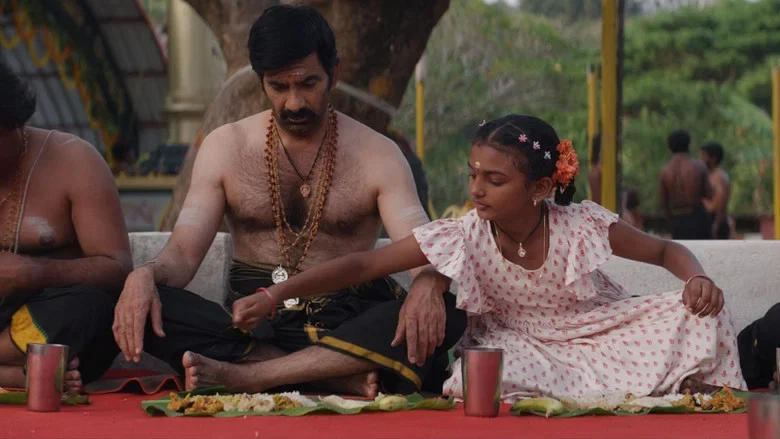
The 41-day Ayyappa Deeksha gives the character a behavioral spine. Trinadh stops drinking during the observance and resumes after it, and the film observes this cycle without moralizing, letting the ritual function as a test he keeps failing.
When the Body Turns Up, the Family Drama Stops Breathing
Gayathri’s commute, a bus to Donkapadu forest, then five kilometres on foot or cycle, is established as a structural hazard before it becomes a plot device. The film treats the girls’ walk to school as a daily risk rather than a scenic interlude.
Dhanalakshmi’s “special classes” operate in the same register of quiet unease, with Babu hovering as her assistant. The threat is institutional before it is criminal, which is precisely why the discovery of a girl’s body in the bushes lands as a rupture.
From that point, Irumudi wants to be two things: an intimate study of a father failing his daughter, and a broad indictment of village infrastructure, school authority, and political protection. The first is compelling. The second arrives with a megaphone.
Ravi Teja Finally Plays a Man Instead of a Machine
There is a moment early on when Trinadh, sober, watches Manikanta eat and does nothing at all. Teja holds the frame in stillness, his face registering a father’s habitual calculation of threat, and the performance suggests a career being quietly rewritten.
His volatility when drinking is not performed as showmanship. Teja plays the drunk scenes with a slackness around the jaw and a delayed response to his wife’s voice, and the contrast with his Deeksha-era discipline is physical rather than declarative.
The confrontation with Goparaju is the film’s emotional hinge, and Teja plays it as accusation rather than grief. Sai Kumar’s Guruswamy, a man whose religious standing has shielded him from scrutiny, absorbs the charge with a stillness that destabilizes the entire moral order of the village.
Priya Bhavani Shankar’s Kaveri has less to do, but her function is clear: she is the witness to a marriage eroded by an unpredictable spouse. Baby Nakshathra’s Manikanta is the film’s emotional center, and her recorded message makes her an active agent after death rather than a martyr.
The Second Half Confuses Exposition With Revelation
Once Manikanta’s audio message surfaces, the film shifts from inference to information. Trinadh learns what the audience has already assembled, and the conspiracy is laid out as a chain of names rather than a system of complicity.
Swasika’s Dhanalakshmi and Ramesh Indira’s Bujji Raju are positioned as the network’s public and private faces, and both performers do what the script allows: one weaponizes pedagogical authority, the other embodies the political protection that makes it sustainable.
But the screenplay stops trusting its own atmosphere. The discovery of the body, the forest route, the school corridors, these spaces had done the work of dread. The climax replaces them with confrontation scenes that explain what the earlier imagery had already implied.
There are logical seams here that no performance can spackle over, and the film’s control visibly loosens once the personal grief becomes a public investigation. The tonal movement between devotional discipline, alcoholism, and child exploitation is handled with more conviction than coherence.
Mythri’s Bet on a Serious Ravi Teja Is a Real Commercial Gamble
Mythri Movie Makers, presenting through T-Series, have built a slate on scale and star-vehicle certainty. Irumudi is a different proposition: a socially engaged family drama with a mass-comedy lead asked to carry grief, sobriety, and accusation without a single crowd-pleasing detour.
That is a genuine box-office risk in a market where Teja’s commercial value has been tied to kinetic energy rather than restraint. The film’s theatrical life will depend on whether family audiences follow him into this register, and whether the Ayyappa devotional framework draws the temple-going demographic that the rural setting courts.
The regional pipeline keeps producing these hybrid dramas, part social issue, part star showcase, and the sustainability of that model depends on scripts that trust their own first acts. This one does not, quite.
The comparison with the tonal patience of Epic – First Semester is instructive: that film let its characters breathe before demanding judgment, while this one rushes to verdict.
What Teja accomplishes here recalls the restrained exhaustion of Liam Neeson's The Fix, where a familiar screen presence is asked to carry moral weight rather than momentum. The difference is that Teja’s film has a stronger first hour and a weaker last.
For a star whose filmography has rarely demanded this kind of interiority, the performance signals a welcome tonal maturity across contemporary Telugu dramas, even when the material around him doesn’t rise to meet it. As audiences and entertainment platforms like Filmyfly frequently monitor, veteran mass leads transitioning into grounded, emotionally vulnerable roles represents one of the most promising evolutions in regional cinema.
The film’s structural ambitions also invite comparison with the broader theatrical landscape mapped by Tyler Cameron Reveals Baby, where a familiar format is asked to hold an unfamiliar emotional weight.
A Father’s Voice Is Not the Same as a Film’s Conscience
The ending asks us to accept that Trinadh’s transformation from protective father to systemic accuser is complete. But the film never quite earns the leap from one dead girl to a village’s worth of endangered daughters.
What lingers is not the conspiracy but the instruction: tell me everything that happens in your day. A film that began by teaching a child to speak ends by discovering it never learned to listen to its own best instincts.
Irumudi is a sincere, uneven, occasionally powerful film that mistakes exposure for resolution, and a star vehicle that briefly forgets it’s a star vehicle, which is the most interesting thing about it.
Irumudi (2026): Ravi Teja Anchors a Father-Daughter Drama That Loses Its Nerve
Visually captivating cinematography, stellar sound design, and commanding performances.
Slight pacing drag in the second act before the climactic resolution.