Maharaja Ending Explained: The Locket, the Birthmark, and Why Selvam’s Death Is the Real Punishment

The locket hits the concrete before anyone speaks. A thin gold chain, the kind you buy for a child who hasn’t been born yet, skidding across dust and rebar while a man with a shattered leg looks down at it and understands, in one sickening instant, exactly whose neck it used to hang around. That’s the cut to black Maharaja has been sprinting toward for two and a half hours. Not a gunshot. Not a killing blow. A piece of jewelry and a birthmark doing the work that no bullet could.
The Quiet War Between Two Fathers Nobody Knew Was Happening
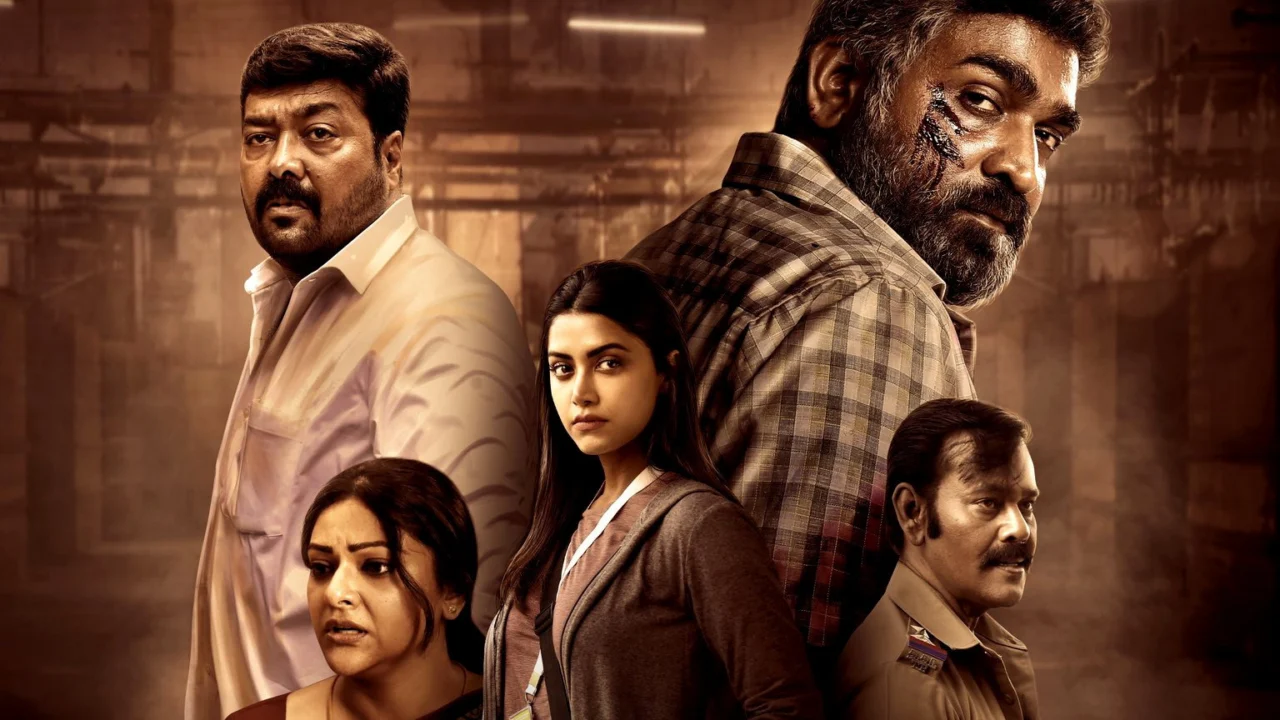
Vijay Sethupathi’s Maharaja spends most of the film looking like a barber who wandered into a kidnapping. He files police complaints about a stolen dustbin. He shuffles through stations with the apologetic posture of a man who’s been told his whole life to take up less space. What the movie withholds until the final act is that every one of those bureaucratic errands was a cover for a second investigation running underneath the first, a hunt for the men who assaulted his daughter Jothi, conducted with the patience of someone who has already accepted he might not survive it.
Selvam, meanwhile, has been running his own operation from the opposite direction. He believes Maharaja destroyed his family. He has spent years constructing a revenge architecture around that belief, recruiting Nallasivam and Dhana, arranging violence with the cold bookkeeping of a man settling a debt. Two fathers, two dead children in their heads, two revenge engines pointed at each other. The film lets both of them believe they’re the protagonist of a straightforward thriller until the floor gives out.
What makes the third act land isn’t the scale of the confrontation. It’s how small the space becomes. As we broke down in our full Maharaja review, Nithilan Saminathan refuses to grant either man the dignity of a clean showdown, the camera keeps them at awkward distances, never quite letting them occupy the same frame comfortably, because they were never actually enemies. They were two halves of the same catastrophe, and the blocking knows it before either character does.
How a Limp and a Stone Turn a Rooftop Into a Confession Booth
The construction site confrontation is shot like a trap closing. Maharaja doesn’t arrive with a weapon. He arrives with information, and when Selvam tries to move, Maharaja brings a large stone down on his leg, not to kill, just to anchor. The sound design goes thin here. No score swell, no dramatic sting. Just the wet crack of impact and Selvam’s breathing changing register as he realizes he’s not going anywhere.
That’s the tactical genius of the sequence. Maharaja has already won the physical fight before it starts, because he’s the only one in the scene who knows what’s actually at stake. He doesn’t need Selvam dead. He needs Selvam still. Still enough to hear what’s coming. Still enough to see who’s walking up the stairs behind him.
When Jothi arrives with her teacher, the camera does something cruel. It holds on Selvam’s face as he registers her presence, and for a beat he thinks he’s looking at a victim he created. Then she starts throwing the recovered jewelry at him (chain, locket, the small pieces Maharaja spent the whole film chasing) and the frame tightens on his hands as he catches one. The locket he bought for Ammu. The one he picked out before prison, before the years he lost, before he convinced himself his daughter was gone.
Why the Birthmark Rewrites Every Scene You Already Watched
The locket alone doesn’t break him. It’s the shoulder. When Jothi turns, or when her clothing shifts during the confrontation, Selvam sees the birthmark, the same mark he used to kiss goodnight on a child he hasn’t held in years. The reveal doesn’t arrive as a twist in the conventional sense. It arrives as a physical recognition, the kind that bypasses language entirely. His body knows before his mind catches up.
This is where the film’s earlier “missing object” investigation retroactively becomes something else. Every scene of Maharaja chasing the stolen Lakshmi, every dusty police station, every dead-end, those weren’t detours. They were the mechanism by which the locket ended up in Jothi’s hands at exactly the moment Selvam needed to see it. The object was never just a keepsake. It was a bridge between two timelines and two fathers, planted in plain sight for anyone paying attention to the way the camera kept returning to it.
The birthmark pays off a quieter thread too. Throughout the film, Jothi is framed in ways that emphasize her as someone being protected rather than someone with agency, always slightly behind Maharaja, always partially obscured, always the thing the plot is moving around rather than the thing moving the plot. The reveal flips that reading. She was never a passive object of two men’s grief. She was the answer to a question neither of them knew they were asking.
Who Walks Away and Who Falls: The Final Moral Ledger
The film ends with a body on the ground and a secret still breathing. Selvam jumps (or falls, the staging leaves just enough ambiguity to sting) after the full weight of what he’s done lands on him. He arranged the assault of his own daughter. He spent years hunting a man who was actually protecting her. There’s no version of that realization a person survives intact, and the film doesn’t pretend otherwise. His death isn’t a villain’s defeat. It’s a collapse.
- Selvam: Dies by suicide after recognizing Jothi as Ammu. Not redeemed, not forgiven, just destroyed by the truth he spent years avoiding.
- Maharaja: Survives, walks away with Jothi, and chooses to bury the full story. His protection comes at the cost of her history.
- Jothi: Lives, but is left holding a version of events that has been curated for her. The film never lets her choose what she knows.
- Nallasivam: Killed by Maharaja during the revenge chain. The police ensure his death stays off the books, which tells you everything about how justice actually operates in this world.
- Inspector Varadharajan: Survives, compromised, part of the machinery that decides which truths get filed and which get buried.
Maharaja’s end-state is the most complicated in the film. He gets the physical outcome he wanted (his daughter alive, the men who hurt her dealt with) but the cost is that he now carries a secret that will shape every remaining day of their relationship. He’s not triumphant. He’s a man who won a war by deciding his daughter never needs to know it happened.
The Locket as a Loaded Object and the Silence That Follows
Saminathan shoots the final sequence with almost no music. The score drops out during the confrontation and doesn’t return until after Selvam’s body has stopped moving. What fills the space instead is ambient noise, wind across the construction site, distant traffic, the small sounds of two people standing near a ledge. It’s the opposite of how revenge climaxes usually sound. No orchestra telling you how to feel. Just the acoustics of a place where something irreversible just happened.
The visual language throughout the film has been built on concealment. Maharaja is constantly framed behind counters, doorways, other people. Selvam is shot in tighter and tighter spaces as the film progresses, his world literally shrinking as his certainty grows. By the finale, both men are on a rooftop, the most exposed location in the film, and yet the truth still can’t be spoken out loud. Even at maximum visibility, the film’s characters communicate through objects and marks rather than words.
That’s the real thematic payload. This isn’t a movie about revenge. It’s a movie about how grief calcifies into secrecy, and how that secrecy outlives the people who built it. Maharaja’s final choice to withhold the truth from Jothi isn’t framed as noble or villainous. It’s framed as inevitable, the only move left for a man who has spent the entire film protecting his daughter by controlling what she’s allowed to see.
Did Maharaja Protect Jothi or Steal Her Story?
The film leaves this deliberately unresolved, and the community has split cleanly along two lines. One camp reads Maharaja’s silence as an act of love, telling Jothi that the man who arranged her assault was her biological father would be a second violation, one she didn’t ask for and doesn’t need. In this reading, his secrecy is the last protective act available to him, and the film endorses it by letting the two of them walk away together.
The other camp reads it as control. Jothi has already survived the assault. She’s already confronted Selvam. She’s already thrown the locket at his feet. The only thing she hasn’t been given is the full context of her own life, and Maharaja decides (unilaterally, without asking) that she can’t handle it. In this reading, the ending isn’t a father protecting his daughter. It’s a father deciding his daughter’s truth belongs to him.
Both readings have textual support. The film’s final shot gives nothing away. There’s also lingering ambiguity about how much the police know and how much they’ve chosen to bury, Varadharajan’s role in the aftermath suggests the official record of what happened on that rooftop will bear little resemblance to what actually occurred.
No Stinger, No Sequel Bait, Just the Weight of What Wasn’t Said
There is no mid-credits or post-credits scene. The film ends on the emotional beat it’s been building toward, the secret between Maharaja and Jothi, and the body of a man who died understanding exactly what he’d done. Any sequel would have to invent a new conflict rather than continue this one, because the revenge loop is closed. Selvam is dead. The men who hurt Jothi are accounted for. The only thing left unresolved is the thing Maharaja has decided will stay unresolved.
That’s a deliberate choice, and it’s the right one. A stinger would have undercut the finality of Selvam’s fall. The film wants you to sit with the silence after the locket hits the ground, not get teased about what’s coming next.
What lingers isn’t the twist. It’s the image of two people walking away from a rooftop, one of them carrying a truth the other will never be given. Maharaja got his daughter back. He just decided she doesn’t get to know how.