Party Animals (2026): Viraj Ghelani Anchors a Farce That Never Finds Its Groove
The school public-address system crackles, and a boy named Mann hijacks it to broadcast his best friend’s love confession to the entire assembly. It is a bright, economical image of friendship as public spectacle, and the last time this film’s chaos feels genuinely controlled.
One New Year’s Eve, Countless Wrong Turns
Ravi Chhabria’s comedy sets its stakes in that opening flashback: Mann Patel (Viraj Ghelani) is the impulsive fixer, Armaan Khanna (Arjun Tanwar) the wealthy heir whose career-launch privilege sits in sharp contrast to Mann’s farsaan-shop reality.
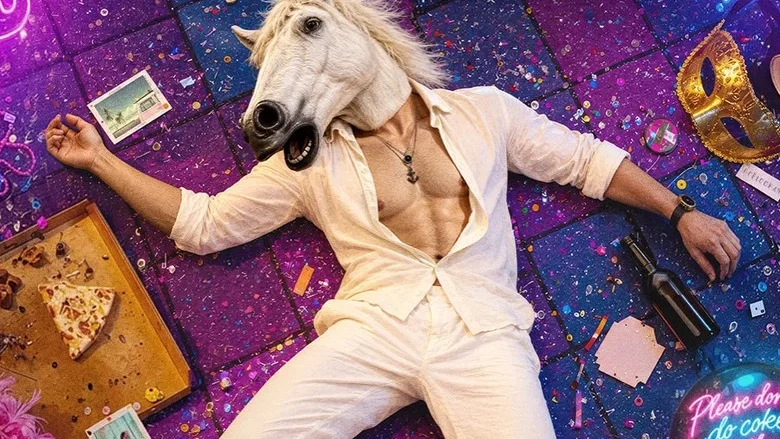
From there, the film maps a single night across a nightclub, a mansion party, an open double-decker bus, a jail cell, and finally a runaway horse. Each location promises escalation. Each delivery mostly proves that escalation is not the same thing as complication.
The central engine is a chain-reaction farce: every attempt to repair a romantic or social misstep manufactures a louder, more public crisis. It is a workable design, and the film leans on it until the mechanism visibly wears.
When Every Solution Becomes a Bigger Problem
The screenplay’s structural logic is almost mathematical: mistake, patch, bigger mistake. That rhythm gives the middle stretch its momentum, but it also means the film front-loads its best comic ideas and then recycles the formula with diminishing returns.
By the time police, goons, and a jail cell enter the frame, the night has stopped building and started accumulating. The farce becomes a series of disconnected incidents rather than a tightly motivated progression, and the two-hour-thirteen-minute runtime begins to press down on material that needed a tighter fuse.
Where the film does connect is in its emotional thread. The friendship premise gives the physical comedy a foundation, and the contrast between Mann’s improvised life and Armaan’s inherited advantages carries a quiet class tension the screenplay never fully exploits.
Ghelani Carries the Comic Weight; Tanwar Gets the Straight Lines
Ghelani is the film’s most reliable asset, and the reviews have been consistent on that point. His Mann is a performer by instinct, the kind of man who turns a private problem into a public event and then improvises his way through the fallout.
His comic timing holds scenes together that the script leaves loose, particularly in the early party sequences where his eagerness to please curdles into visible panic. The performance has a scrappy, unpolished energy that suits a character defined by social aspiration.
Tanwar’s Armaan is a harder read: a man whose romantic stakes with Simran (Jaanya Joshi) are meant to anchor the emotional through-line, but whose wealthy-heir passivity makes him a reactive presence in his own story. The romantic material between them never generates the friction the plot requires.
Joshi’s Simran functions as the childhood memory that connects the school confession to the adult complications, but she is given little to do beyond being the object of Armaan’s history. The supporting ensemble, party guests, cops, goons, fills the frame with noise without adding much comic texture.
Direction That Escalates but Rarely Deepens
Chhabria’s staging has a clear spatial intelligence: the move from nightclub to mansion to party bus to jail gives the film a visible ladder of consequence. The locations themselves do the narrative work, and that is a legitimate directorial choice.
What the direction lacks is control over the comic rhythm. Successive incidents are staged with the same volume and urgency, so the film never modulates between the absurd and the intimate, and the runaway horse, arriving late, reads as desperation rather than escalation.
The film’s visual progression is its strongest craft element, but the pacing betrays it. The first half establishes Mann and Armaan’s contrast with readable clarity; the second half stretches the same joke across too many arenas.
A Farce That Mistakes Volume for Rhythm
The comedy here is built on social embarrassment, and the school PA sequence remains the cleanest example: loyalty, humiliation, and risk compressed into one public act. That scene understands the genre’s real engine, private feeling made public.
Later sequences lose that precision. The party-to-party movement, the fights, the police intervention, and the jail cell all operate at the same pitch, so the film’s comic escalation flattens into repetition rather than accumulation.
Compared to the more disciplined tonal control on display in Yellowjackets Season 4, this film’s refusal to vary its register becomes a structural liability. Chaos needs contrast to register as chaos.
The romantic complications that should give the night emotional stakes are treated as another logistical problem to solve, which leaves the film’s central friendship, the one thing that could ground the farce, undernourished by the final act.
The Commercial Arithmetic of a Creator-Led Debut
Yoodlee Films, a Saregama company, is backing a star whose primary currency is digital reach rather than theatrical draw. That is a deliberate bet on a creator-led audience crossing over into the exhibition market.
The A certificate and nightlife-heavy setting narrow the family audience, which puts the film’s commercial ceiling squarely on Ghelani’s existing fanbase and viewers seeking broad Hindi comedy. The theatrical window will be short.
For comparison, the recent performance of Forgotten Island illustrates how quickly a mid-budget release can lose its exhibition footing without strong word-of-mouth. This film faces the same arithmetic.
The broader Hindi comedy space is crowded with better-reviewed options, and the genre’s theatrical health depends on word-of-mouth that this film’s reception does not suggest it will generate.
The Verdict: A Friendship Comedy That Forgets the Friendship
The film’s ending, wherever the night finally leaves Mann and Armaan, matters less than what the journey reveals: a comedy that trusts escalation more than character, and volume more than rhythm.
Ghelani’s performance is the film’s real discovery, and the school PA scene is its clearest evidence that the material had a sharper version of itself available. The rest of the night is a long, loud detour away from that promise.
For a genre that thrives on precise embarrassment and earned absurdity, the film’s refusal to modulate its comic register is the difference between a farce and a commotion. The chaos is real. The groove is not.
Party Animals (2026): Viraj Ghelani Anchors a Farce That Never Finds Its Groove
Visually captivating cinematography, stellar sound design, and commanding performances.
Slight pacing drag in the second act before the climactic resolution.