Hum Mein Shahenshah Koun: Rajinikanth’s Lost 80s Epic Finally Surfaces

The Rajasthan dust hasn’t settled on this one yet. Harmesh Malhotra’s long-buried action drama finally sees the light of day, carrying the unmistakable weight of a bygone era on its shoulders.
This is not a film that will be judged on contemporary terms, because it was never made for them. It is a relic, preserved in amber, now presented in a revived technical form that makes its vintage DNA even more pronounced.
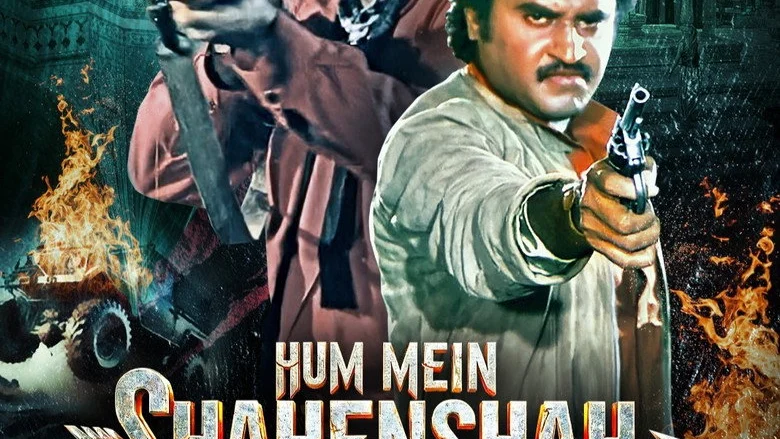
Rajinikanth Commands a Frame That Belongs to Another Age
The Superstar’s presence here is the single greatest reason to engage with this release. His register predates the mannered stylisation of his later superstardom, and that rawness carries a curiosity value that modern prints cannot replicate.
One watches him and wonders what this film might have meant had it arrived on schedule. The delayed release has transformed a straightforward star vehicle into an archaeological artifact, and Rajinikanth’s performance becomes a study in what Hindi cinema expected from its leading men in that specific window.
Direction and Screenplay: A Familiar Engine, A Forgotten Roadmap
Malhotra’s direction operates on the classic mainstream action-drama setup, with a power struggle between rival Rajput families driving the narrative forward. The linear structure is exactly what one would expect from the era, no more, no less.
The screenplay’s weakness is its predictability, a charge that feels almost unfair given the film’s vintage. Authority, rivalry, and the construction of public power are the themes, and they are handled with the broad strokes that defined commercial Hindi cinema of that period.
The Genre Core: Feudal Action and Family Feuds
The action here is not about choreographic innovation or stunt geography. It is about the staging of power, with the Rajasthan backdrop serving as a feudal arena where two families collide over authority and revenge. The setting does half the work, lending an operatic scale to the conflict.
The large ensemble fits this multi-character structure, allowing the film to shift between factions without losing its central thread. Jagdeep’s presence signals a comic interlude, while Sharat Saxena and Prem Chopra exist in the orbit of menace that this genre required as standard equipment.
What the revival presentation adds is a layer of historical curiosity. The restored visuals may not match modern technical standards, but they preserve a texture that contemporary filmmaking has long abandoned. That texture is the film’s real protagonist.
Supporting Cast: A Roster That No Modern Film Could Assemble
Shatrughan Sinha brings his signature baritone and confrontational energy to the proceedings, a reminder of why he was the era’s preferred antagonist-turned-hero. Hema Malini’s inclusion signals the film’s ambition to blend star power with conventional romance, though the research offers no scene-level detail to analyse her specific beats.
Amrish Puri and Prem Chopra anchor the villainy, and their casting alone tells you the register this film operates in. These were men who could make a single dialogue delivery feel like a threat and a promise. Anita Raj and Jagdeep round out the ensemble, each signalling a different genre obligation that the film dutifully fulfils.
For a modern viewer, the pleasure here is not in individual performances but in the collective chemistry of a cast that could never be reassembled today. I found myself more interested in the archival value than in any single actor’s craft choices.
Box Office, Controversy, and the Curious Case of a Delayed Release
The film’s decades-long delay after completion is its most defining controversy, with production circumstances preventing a timely release. This backstory has fuelled audience curiosity, drawing attention from those fascinated by the idea of a lost 80s epic finally surfacing.
There is no verified trade commentary on box office performance, and no reliable critic consensus exists to guide viewers. The audience interest is driven primarily by nostalgia and the novelty of the revival, not by any documented critical or commercial momentum.
This is a release that will appeal to those who collect cinematic curiosities. For anyone expecting a polished contemporary action drama, the experience will feel like finding an old photograph album in a dusty attic.
For those who enjoy revisiting the textures of vintage Hindi cinema, browse more Hindi Action reviews.
Who Should Watch, Who Should Skip
If you are a Rajinikanth completist or a scholar of Hindi cinema’s commercial evolution, this is essential viewing. The film offers a window into a style of filmmaking that has completely vanished from the mainstream.
If you need verified critical consensus or contemporary filmmaking craft, this will frustrate you. The best format is a regular theatrical presentation, or OTT when it becomes officially available, with the understanding that you are watching history, not a new release.
This film shares its archival revival spirit with Dacoit review, another title that wrestles with the weight of its own ambitions.
Hum Mein Shahenshah Koun is a fascinating failure of timing, a film that finally exists in a world that no longer knows how to watch it, and I would rate it a generous 2.5 out of 5 for its historical curiosity alone.
Its delayed-release saga also echoes the tonal struggles of Toaster verdict, where the premise burns out before the finish line.