Aakhri Sawal (2026): Sanjay Dutt Anchors a Debate That Stumbles Into Preachiness
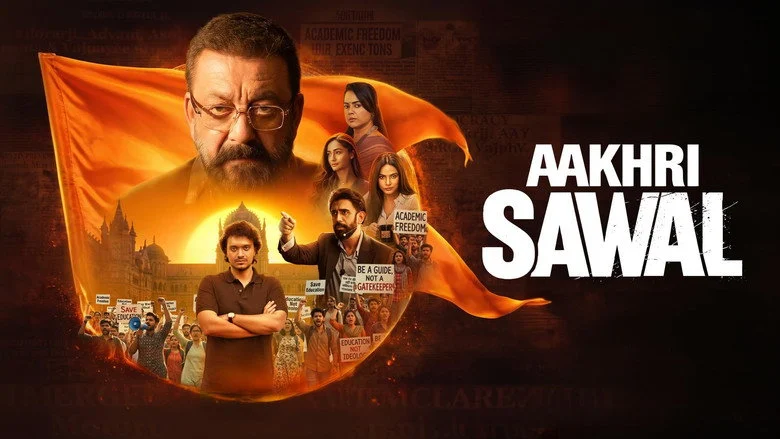
There is a moment in Abhijeet Mohan Warang’s Aakhri Sawal where a lecture hall turns into a battlefield, and Sanjay Dutt’s Professor Gopal Nadkarni stands at the chalkboard like a man who has decided that losing the argument is worse than losing his job. The room goes quiet, the camera holds, and for a brief stretch, the film feels like it might actually cut deep into the flesh of contested history. Then it escalates, and you feel the screenplay reaching for thunder it cannot quite hold.
This is a Hindi drama that wants to be a provocation first and a movie second, and that ambition is both its spine and its stumbling block.
Sanjay Dutt’s Gravitas Carries the Film’s Ideological Weight
Dutt is the engine here, and the reviews are unanimous on that point. He doesn’t just deliver lines; he occupies the frame with the worn authority of a man who has spent decades defending positions he no longer fully believes in. His scenes crackle with the tension of someone who knows the cost of public argument.
When Nadkarni faces his students, you feel the weight of a professor who has become the controversy. Dutt’s performance powering the film is the one element every critic agrees on, and it is easy to see why, he turns ideological confrontation into something physical.
Warang’s Direction Has Substance but Loses Its Grip on Restraint
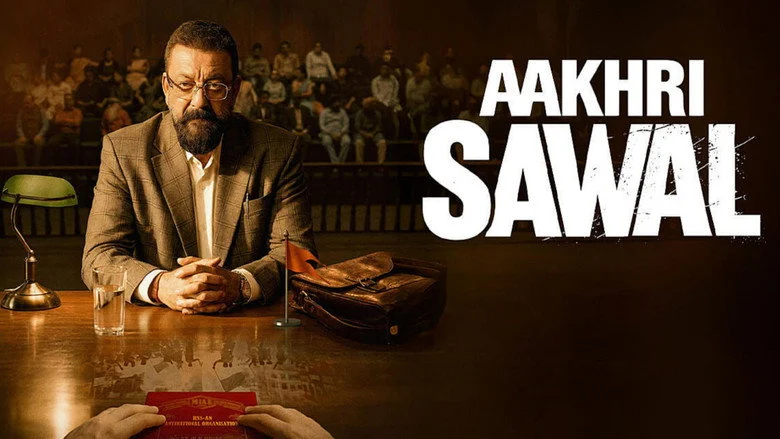
Director Abhijeet Mohan Warang clearly has a thesis, and the film’s substance is undeniable. The premise, a debate over history and belief that spirals into political confrontation, is handled with a seriousness that mainstream Hindi cinema rarely risks. You can feel the intent in every frame.
But the dramatic excess is hard to ignore. The film keeps reaching for a crescendo when a whisper would have landed harder. Warang’s strength is the debate; his weakness is knowing when to stop escalating it.
The Genre-Core Execution: A Drama Torn Between Debate and Declaration
As a drama, Aakhri Sawal is built on talk, not action, and that is a risk. The film’s central confrontation is intellectual, and the screenplay commits to that structure with a linear, debate-heavy rhythm. There is no escape hatch into spectacle, no action sequence to reset the tension. It is a film that trusts its argument to hold attention.
That trust is sometimes rewarded. The discussion-oriented tone is the film’s most distinctive feature, and it gives the drama a texture that feels closer to a stage play than a commercial feature. The ideological tension is real, and the film does not shy away from the messiness of contested truth.
But the execution wobbles when the drama overreaches. Critics note that the tone veers between provocation and preachiness, and the film lands somewhere in between, never fully committing to either. The dramatic choices prevent it from reaching its full potential, as India Today put it, and you feel that ceiling throughout.
Amit Sadh, Sameera Reddy, and the Supporting Cast’s Limited Canvas
Amit Sadh, as Aditya Rao, brings a coiled intensity to his scenes with Dutt, even if the script gives him little to work with beyond reaction shots. His presence signals a generational clash, the young voice pushing against Nadkarni’s entrenched positions, and Sadh’s restraint is a smart counterweight to Dutt’s amplitude.
Sameera Reddy, playing Professor Pallavi Menon, exists mostly as a witness to the central argument, but her casting suggests the film’s intent to frame this as an institutional crisis, not just a personal one. Namashi Chakraborty’s Vicky Hegde feels like the audience surrogate, the student caught between the two poles of the debate. The supporting cast is competent, but the screenplay keeps them at arm’s length from the fire.
Firstpost noted that “it’s a film that doesn’t give clear answers. The film asks questions and the answers are up to us.” That ambiguity extends to the characters, they are defined by their positions in the debate, not by their inner lives.
For more Hindi drama reviews that wrestle with ideology and belief, browse the Hindi Thriller reviews archive.
The Provocation Works, but the Preachiness Undermines It
The Times of India called it “less like a film built to please everyone and more like a film built to provoke discussion, ” and that is the most accurate verdict. Aakhri Sawal is not a crowd-pleaser, and it does not pretend to be. The audience response mirrors the critics, praise for Dutt’s screen presence and the subject matter, complaints about overwritten drama and a lack of resolution.
Hindustan Times’ critique that the film “feels less like a thought-provoking debate and more like a film caught between provocation and preachiness” is the sharpest arrow in the quiver. The film wants to be a question, but it keeps drifting toward a sermon. That tension prevents it from being the debate-starter it clearly wants to be.
It is a bold swing, and I respect the intent even when the execution wobbles. But boldness without discipline is just noise.
If you are a fan of Dutt or a class audience that enjoys ideological drama, this is worth a look. If you want light entertainment or a film that gives you neat answers, stay away. Watch it on a regular screen with someone who likes to argue, the discussion after will be better than the film itself.
Aakhri Sawal is a 3 out of 5, a film with real substance that keeps tripping over its own dramatic excess, powered by a Sanjay Dutt performance that deserves a sharper screenplay.
For a sharper take on meta-cinema and satire, check out Mollywood Times review.
And for another performance-led drama that lands hard despite a patchy screenplay, see Maa Behen verdict.
Aakhri Sawal (2026): Sanjay Dutt Anchors a Debate That Stumbles Into Preachiness
Visually captivating cinematography, stellar sound design, and commanding performances.
Slight pacing drag in the second act before the climactic resolution.