Dilwali Diwali (2026): Mihir Ahuja Proves the High-Rise Is Never Home
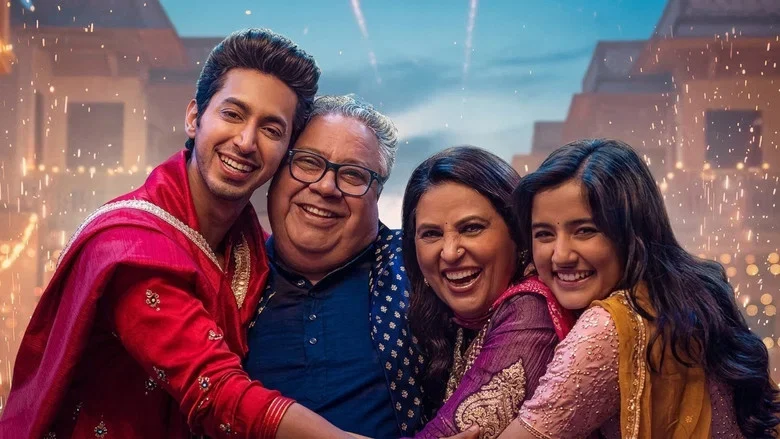
Ritesh Menon opens on a son standing in a Punjab doorway with keys to a high-rise he believes will absolve years of absence. The apartment is the film’s real antagonist, and it never blinks.
When the Gift Arrives Before the Apology
Ansh Sikkha returns from abroad carrying the keys to a modern apartment, offered to his middle-class Punjabi parents as proof of filial success. Menon stages the reveal with the flatness of a property viewing rather than a homecoming, and that choice cuts.
The premise is legible within minutes: prosperity as substitute for presence. What Menon withholds is the confrontation, letting the object sit in the room like a guest nobody invited.
This is where the film’s ambition shows its seams. The apartment carries class meaning, but Menon rarely lets the camera interrogate it, framing rooms as backdrops rather than arguments.
A Diwali Table Loaded With Unspoken Ledgers
The family gathering supplies the film’s structural engine, forcing relatives with divergent definitions of a fulfilling life into one room. Menon uses the festival’s ritual obligations as pressure, not decoration.
Yet the screenplay keeps the disagreement verbal and abstract, rarely anchoring it in a specific gesture or object. When a cousin questions Ansh’s choices, the camera stays wide and polite, refusing the claustrophobia the scene needs.
The friction is real, but it is also tidy. Menon trusts conversation over collision, and the film’s middle stretch drifts toward the declarative.
Mihir Ahuja’s Stillness and the Weight of Being Right
Mihir Ahuja plays Ansh with a controlled, almost managerial calm, his shoulders squared as if he is still presenting a quarterly report to his parents. The performance works because he never pleads.
Watch his hands at the dining table: they stay folded, thumb pressing into the other, a small tell of a man doing arithmetic on his own worth. It is the film’s most precise physical detail.
The restrained exhaustion Ahuja brings to the final reconciliation recalls the psychological weight carried in Haunted Hotel Season 3, where silence also does the heavy lifting. Here, though, the silence is less earned.
Manoj Pahwa and Neelu Kohli Carry the Domestic Textures
Manoj Pahwa and Neelu Kohli anchor the parents with the kind of unshowy domestic rhythm that makes a Punjabi living room feel lived-in. Pahwa’s character rarely raises his voice; his refusal is a shrug and a turned back.
Kohli’s mother figure moves through the kitchen with practiced economy, and her one long look at the new apartment’s empty shelves speaks louder than any written line. The supporting relatives, by contrast, function as a chorus without individual weight.
That imbalance is the film’s quiet failure: the parents are specific, the extended family is a category. Menon never gives the cousins a scene that belongs to them alone.
A Director Who Trusts the Room Too Much
Menon’s formal discipline is evident in the film’s refusal to decorate the family conflict with thriller mechanics or manufactured reversals. The camera stays at eye level, the lighting warm and unremarkable.
But that restraint becomes a limitation. When Ansh finally walks through the empty high-rise, the framing is so neutral that the space never feels like a betrayal, only a location.
Just as the sharper spatial discipline in Vijay Sethupathi’s festival appearances foreground presence over spectacle, Menon strips away visual flourish to prioritize raw emotional friction. The difference is that Sethupathi commands the frame; Menon’s rooms often outshine his people.
The score, sparse and unobtrusive, does its job without ever pressing the film’s emotional claims. It is a score that trusts the actors, which is both generous and slightly evasive.
The Ending That Refuses to Punish Anyone
The resolution turns on Ansh reassessing the relationship between the apartment he bought and the home his family actually recognizes as theirs. Menon does not stage a showdown; he stages a return.
That choice is thematically coherent and dramatically soft. The film’s final image suggests that belonging cannot be purchased, but it never forces Ansh to reckon with the cost of his absence.
The moral fallout here parallels the unresolved tension analyzed in Pyre, where quiet also conceals a reckoning the film declines to stage. Menon’s version is gentler, and gentler is not always braver.
What lingers is not the climax but the apartment’s silence, a space that never becomes a home because no one ever argues inside it loudly enough.
Netflix’s Family Drama Bet and the Limits of the Format
As a Netflix title, Dilwali Diwali enters a crowded slate of domestic dramas where the streamer has learned that festival settings and recognizable family archetypes travel well. The financial logic is clear: low-risk, culturally specific, broadly exportable.
But the format also flattens ambition. A theatrical release might have demanded a more forceful climax; a streaming premiere rewards the gentle resolution Menon delivers, because viewers can pause and return without losing momentum.
For Mihir Ahuja, the film is a credible step toward leading-man territory, though it does not yet prove box-office leverage. For Netflix, it is a competent addition to a library rather than a defining title.
This patient character study signals a welcome tonal maturity across contemporary Hindi dramas, proving that tension can thrive without manufactured plot theatrics. It also proves that tension needs a sharper knife than this film is willing to wield.
The Verdict: A Homecoming That Never Quite Arrives
Dilwali Diwali is a thoughtful, well-performed family drama that mistakes restraint for depth and conversation for confrontation. Ahuja and his on-screen parents give the film a pulse; the screenplay gives them a living room and asks them to be polite.
The film’s final lesson is that a high-rise can hold a family but never a home. What it cannot quite admit is that the same is true of a movie that keeps its characters at a courteous distance.
Menon has made a film about the gap between what we give and what is received. He has also made a film that keeps that gap safely on the other side of the frame.
Dilwali Diwali (2026): Mihir Ahuja Proves the High-Rise Is Never Home
Visually captivating cinematography, stellar sound design, and commanding performances.
Slight pacing drag in the second act before the climactic resolution.