Pehla Pyaar Doosri Baar (2026): Sparsh Walia’s Reunion Rom-Com Fumbles Its Spark
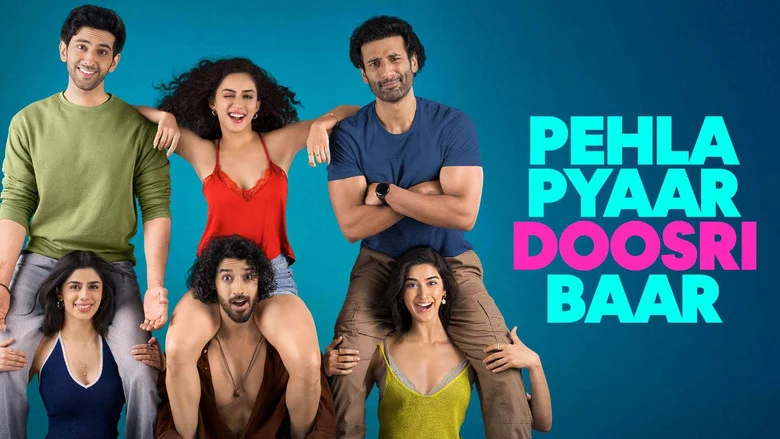
The drunk pact is struck before anyone has finished their first round: three Delhi office drones will drive to the hills and finally confess to the crushes who got away.
Anuj Saini’s film believes that decision is romantic. It is actually the last gasp of people who have run out of ways to avoid being adults.
A Reunion Premise That Mistakes Nostalgia For A Plan
Gautam Govind Sharma, Govi to his friends, is introduced in the fluorescent purgatory of a Delhi workplace, watching a promotion pass him by while wedding invitations pile up on his desk.
Sparsh Walia plays him with a slack, deferential posture, hands permanently in pockets, shoulders rounded as if apologising for occupying space.
The screenplay, structured as three interlocking pursuits that gradually collapse into one group objective, sends Govi after Gehna, Vedant after Simran, and Shivi after Karan.
Each target represents a different flavour of unfinished business, and for roughly forty minutes the film hums on the friction between who these people were at seventeen and who they have become.
Then Mussoorie arrives, and with it the realisation that the film has confused a setting with a thesis.
When Intimacy Becomes A Contract, The Comedy Stalls
The most instructive sequence finds Govi and Gehna alone, the reunion buzz wearing off, and Alisha Chopra’s Gehna making her position plain: she has been hurt before, she is not interested in a holiday fling, she wants permanence.
Watch Walia’s face in that moment. The jaw tightens, the eyes drop to middle distance, and the entire fantasy he drove four hundred kilometres to protect quietly dies in his throat.
It is a genuinely uncomfortable scene, and the film does not quite know what to do with the discomfort it has manufactured.
Instead of sitting in it, the screenplay retreats into the familiar commitment-phobe beat, the man who wanted the girl until she wanted him back, and the sharpest observation in the movie gets buried under a shrug.
Gehna’s line lands with real bite, a woman stating plainly that her own desirability has become a liability. Chopra delivers it with a flat, unimpressed gaze that suggests she has had this conversation many times and expects it to go badly again.
Shivi’s Makeover And The Cost Of Being Called Cute
Sargun Kaur Luthra is handed the film’s trickiest assignment: a blunt, profane woman who refuses the “cute” label and reinvents her appearance to be taken seriously as a sexual being.
Luthra plays the transformation with a brittle aggression, the new clothes worn like armour rather than invitation, and there is a moment of real pathos when Karan calls her cute anyway and she visibly deflates.
What follows, intimacy, then the slow dawning that his interest was never emotional, is the film’s most honest passage about how badly women are taught to read male attention.
That the screenplay then routes her arc through a makeover montage rather than an interior reckoning is the film’s central failure of nerve.
The comedy around it is broader and less interesting, with the trio’s banter carrying the slack that the romantic pairings cannot.
Vikesh Arrives And The Clock Starts Ticking
Kunal Vaid’s Vedant has the most conventional structure: the late confession, the reciprocal spark with Simran, and then Gobind Singh Mehta’s Vikesh turning up with a wedding date already set.
Mehta plays the fiancé with a pleasant, unremarkable confidence, no villainy, no menace, just the quiet fact of an existing commitment that Vedant cannot argue with.
It is the correct choice, because the obstacle here is not a man but time, and the film’s second half narrows toward a rescue mission that gives the final act a shape the middle section badly lacked.
The problem is that Sakshi Vaidya’s Simran never quite becomes a person with agency; she is a prize to be reached before a deadline, and the film’s emotional stakes thin accordingly.
Vaid, for his part, brings an eager, slightly desperate energy to the pursuit that works better than the material deserves.
Anuj Saini’s Direction Finds Rhythm But Not Chemistry
Saini has an eye for the contrast between Delhi’s grey office corridors and the green, nostalgic sprawl of the hill station, and he stages the reunion introductions with a loose, overlapping chatter that feels lived-in.
Where he falters is in the intimate two-handers, which he shoots in flat, evenly lit medium shots that give the actors nowhere to hide and no visual metaphor to lean on.
The music does considerable heavy lifting, swelling at precisely the moments the dialogue cannot manage, and it is the most persuasive argument the film makes for its own romance.
By the time the trio return to Delhi and redirect their energies toward Vedant’s mission, the pacing has tightened but the emotional throughline has frayed into three competing threads.
The ensemble’s chemistry is amiable rather than combustible, which is fatal for a film built entirely on the premise that these people cannot stop thinking about each other.
Luv Ranjan’s Banner Bets On Newcomers In A Crowded Market
With Luv Ranjan attached as producer, the film arrives on a slate that has built its commercial identity on friendship-driven romantic comedy, and the newcomer-led casting is a deliberate financial calculation.
It keeps the budget lean and positions fresh faces as the selling point, but it also means the film carries no star guarantee into a theatrical market that increasingly rewards established names or spectacle.
The opening-day India net figure of ₹0.22 crore reported by Sacnilk is a sobering indicator of how little traction the release has generated, and the absence of any verified first-week total or budget figure makes a full trade assessment difficult.
What is clear is that the reunion-romance template, without a star or a genuinely fresh angle, is struggling to justify a theatrical outing in a landscape where the genre increasingly lives on streaming.
For a fuller sense of how the current Hindi comedy slate is faring, the broader picture across contemporary hindi comedys suggests audiences are rewarding films with a sharper comic voice.
The Ending Resists The Grand Gesture, And That Is Its One Real Virtue
The climax builds toward an intervention before Simran’s wedding celebrations conclude, and the film’s refusal to guarantee that the gesture will work is its most mature instinct.
What it will not do is sit with the aftermath, the possibility that all three friends return to Delhi having learned something unflattering about themselves.
Instead it reaches for resolution, and in doing so confirms the suspicion that Sarvagunn Sampann also carried: a promising premise can be smothered by a screenplay unwilling to trust its own darkness.
There is a version of this film, colder, funnier, more honest about the cruelty of revisiting old crushes, that the material clearly contains.
Saini and his cast gesture toward it in scattered moments, particularly in Chopra’s wounded composure and Luthra’s armour-plated makeover, but the whole never coheres into the film those fragments promise.
What remains is a romantic comedy that understands loneliness better than it understands love, and mistakes a hill station for a second chance.
Pehla Pyaar Doosri Baar (2026): Sparsh Walia’s Reunion Rom-Com Fumbles Its Spark
Visually captivating cinematography, stellar sound design, and commanding performances.
Slight pacing drag in the second act before the climactic resolution.