Keira Knightley Says Love Actually Quotes “Mean Nothing To Me
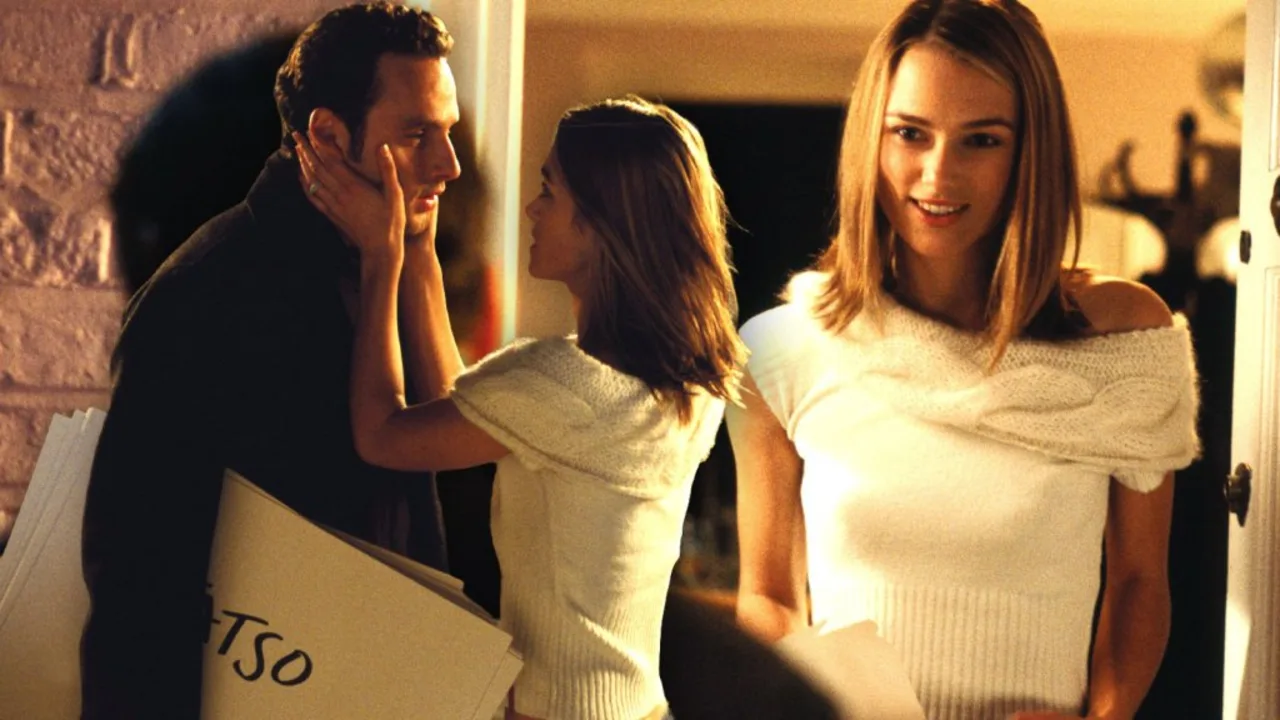
- The Scoop: Keira Knightley told Heart that fan quotations from Love Actually “mean nothing to me,” having seen Richard Curtis’s 2003 ensemble romance only once at its premiere.
- Production Footprint: Knightley was 17 during the shoot and on set for roughly one week, a sliver of screen time that became one of the film’s most replayed passages.
- Holiday Grip: Two decades on, the Christmas corridor still routes seasonal viewers back to the title, keeping its cast members fielding the same doorstep dialogue.
Keira Knightley has confirmed she has watched Love Actually exactly once, at its 2003 premiere, and that fans reciting the film’s dialogue to her “means nothing to me.” The admission lands two decades after Richard Curtis’s ensemble romance became permanent holiday-season furniture.
The actor, then 17, worked on the production for roughly a week before the film opened. That brief window has since generated a lifetime of doorstep encounters she describes with disarming detachment.
“I know that people have a particular look on their face and then they say things to me and I know that means they’re quoting Love Actually, but I don’t really know what it is. It means nothing to me.”
A Week on Set, a Lifetime of Quotations: The Arithmetic of a Small Role
Knightley’s screen time in Curtis’s interwoven romance is modest by any measure, yet her storyline opposite Chiwetel Ejiofor and Andrew Lincoln carries the film’s most dissected sequence. The gap between a week’s work and twenty years of public recital is the strange ledger of a Christmas perennial.
She frames herself as the least informed person in the room about her own film. “I have not watched Love Actually since the premiere, which was when I was 18,” she said, adding flatly, “I think I’m the person that knows it the least of anybody.”
Curtis built the 2003 release as a lattice of separate love stories, and its afterlife rests on that structure. Audiences return annually to individual threads rather than the whole, which is precisely why one performer can be stopped on the street for lines she never committed to memory.
The Christmas Corridor: Why a 2003 Title Still Owns December
Holiday-season scheduling has made Love Actually a fixture of December viewing rotations across broadcast and streaming, a slot that regenerates cultural currency every year without a single new frame of footage. That recurring exposure is the engine behind the doorstep quotations.
For the ensemble, the effect is uneven. Actors with larger arcs absorb the seasonal attention; those with brief passages, like Knightley’s, receive the same recognition with none of the recall.
The dynamic echoes what contemporary romances face when they chase the same December window, as seen in recent holiday-adjacent comedy releases that arrive without a built-in annual rewatch cycle. A single festive season cannot manufacture two decades of repetition.
Knightley’s candor also lands as a small case study in how franchise-scale familiarity gets distributed unevenly across a cast. The film’s commercial identity belongs to the collective; its quotable moments belong to whoever happened to be in the scene.
No Sequel, No Reboot: A Legacy Sustained by Repetition Alone
There is no new installment, remake, or reunion production attached to the title. Its durability is entirely inherited, carried by yearly screenings and the audiences who treat the film as ritual rather than narrative.
That makes Knightley’s remarks a useful stress test for legacy IP without active exploitation. A property can remain culturally loud while its own participants remain genuinely estranged from it, and the disconnect costs the title nothing at the seasonal box.
For the wider business, the takeaway is that holiday catalog titles function as recurring inventory, generating attention and platform engagement at zero production cost. Tracking that recurring value sits at the center of our release calendar coverage each December.
The economics favor the library holder, not the performer. Every winter cycle reactivates the asset and drives tune-in and subscriber retention across streaming platforms, while the actors who furnished its most-quoted scenes collect recognition without royalties on the memory.