DANG! Season 1 Ending Explained: Ruthie’s Recital Confession, the Betrayal, and the Bus Ride Home
DANG! Ending Explained: Ruthie’s Recital Confession, The Betrayal, And The Sibling Reckoning
The last image of DANG! isn’t a hug. It’s the dim cabin of a southbound bus, the Mass Pike scrolling past in sodium-orange smears, and Ruthie’s thumb hovering over a text she never expected. Her mother has written about a building collapse in another country, a tragedy that killed strangers, before adding a single quiet line: do you still want to stay in New York? No apology. No mention of the baby, of Peter, of Warren, of the scene that tore the roof off a Boston dance recital hours earlier. Eight episodes of exposure and rupture, and the season closes on a door that only creaks open an inch. Anyone waiting for a clean reconciliation is reading the wrong family.
The Recital Trap: Boston, the Painted Smile, and the Dinner Table Massacre
For most of its runtime, Netflix’s DANG! (all eight episodes dropped September 8, 2026, in a single cinematic gulp) runs on the friction between two versions of the same family. There’s the New York version: Andrew, the anxious middle child, demoted after a data breach and quietly trying to broker peace between everyone he loves. Eunice, the youngest, funding her chaos through OnlyFans and treating responsibility like a coat she keeps forgetting at the bar. And then there’s Ruthie, the eldest, who arrives pregnant with colleague Peter’s child after leaving her husband Warren, carrying a suitcase and a mountain of unspoken failure.
The season funnels every one of those secrets into a Boston trip. Their mother is dancing in a Chinese cultural recital, and the siblings decide this is the moment to tell their parents the truth. But Ruthie, the lifelong keeper of the “perfect daughter” flame, panics at the dinner table the night before. She does the cruel arithmetic of self-preservation: to soften the blow of her own scandal, she serves up her siblings as the appetizer. Andrew’s demotion gets aired. Eunice’s online work gets weaponized. The camera holds on Andrew’s face as it empties, and on Eunice’s hand going still around a teacup. Ruthie isn’t just deflecting. She’s cutting them loose to save her own seat at the family table.
What Ruthie doesn’t count on is Eunice’s hurt curdling into spite. A single text to Warren from a bathroom stall, and the trap springs shut.
On That Stage: Confession Framed Like a Combat Sequence
The finale’s centerpiece isn’t a shootout. It’s worse. It’s a public recital hall, folding chairs, and a mother mid-performance in red silk, fans rippling through choreography that demands total unison. Director’s choice here is quietly ruthless: the camera frames the siblings standing in the wings, half-lit, while their mother commands the spotlight. They are interlopers in a world built on order, and the show knows it.
When Andrew and Eunice step forward, the editing slows to something almost unbearable. The applause dies. The PA system hums. Andrew admits his demotion into a microphone that squeals, and Eunice (raw, shaking, defiant) owns her OnlyFans work in front of her parents’ friends. But this isn’t shame. The camera pushes in close enough to catch the tears on Eunice’s jaw as she says she is done pretending. They are not confessing to their parents. They are confessing for Ruthie, showing her that being the family’s wreckage isn’t a life sentence, that they can all be broken together.
Ruthie takes the microphone, and the room’s geometry shifts. The wide shot tightens to a two-shot of mother and daughter across a sea of chairs. The mother mouths the words go back to Warren, still scripting Ruthie’s life from the audience. Ruthie cuts her off with the full truth: the baby is Peter’s, the marriage is over, she is raising this child alone. Warren, who arrived with a suitcase of his own expectations, simply walks out mid-line. A man exits the way a canceled plan exits a calendar. The father says nothing, but his hand finds his wife’s arm and holds it, and that small grip is the loudest thing in the room.
The Perfect Daughter’s Tell: Ruthie’s Betrayal and the Clues We Missed
The twist isn’t that Ruthie betrayed her siblings, that lands like a slap in real time. The twist is what the betrayal reveals about the whole season. Ruthie wasn’t protecting her parents’ opinion of her. She was protecting the only identity she has ever been allowed to hold. The eldest daughter’s Mandarin fluency, worn like a medal the younger two can’t earn, wasn’t just language. It was citizenship in a country her siblings were exiled from: the country of parental approval, with its strict immigration policy on failure.
Rewatch the earlier episodes with that in mind, and the breadcrumbs surface everywhere. Ruthie’s children’s book recommendations, all political centrism and burglar-proof security, betray a woman pathologically allergic to disruption. Her volatility around Peter’s calls, the way she arrives at Andrew’s door already braced for judgment. And in an episode that felt like filler the first time, Ruthie watches Andrew and Eunice squabble over cold noodles and her face goes slack with envy precisely because they can fight without fear of losing each other. She could never afford that fight. She was too busy being the one who needed to make the culture proud for trying to keep up with the culture at all.
Her speech in Boston destroys that role with a microphone and a heartbeat. And what survives the wreckage is something messier, better, and far less impressive at dinner parties: a sister.
Ledger of the Damaged: Who Loses the Crown, Who Finds the Door
The moral audit of that recital hall cuts clean, and nobody walks away unscathed.
- Ruthie trades away her favored-daughter status and gets, in exchange, the terrifying freedom of being a real person. She returns to New York with a baby on the way and no script to follow.
- Andrew: the people-pleaser who once came out to the parents and received only silence, finally sees their support arrive in indirect form. He gets hope, which is the most this family knows how to give.
- Eunice changes nothing about her life and everything about her shame. She is no longer hiding, and that makes her the bravest one of the trio.
- Warren: the respectable ex-husband, exits the story when Ruthie names Peter. He was never a character, just a container for everyone else’s idea of security, and now he is empty.
- The mother loses her choreographed future and gains a daughter who finally told her the truth on her own turf. She does not fall apart in public. She is, after all, still a performer.
Four adults who have to live with what got said, which for this family is the real war.
Red Silk, Greyhound Vinyl: The Currency of Indirect Love
The show does something clever with its visual grammar in the finale stretch. Early episodes trap the siblings in cramped interiors: the narrow apartment hallway, the cubicle grid where Andrew’s demotion happened, the bathroom stall where Eunice texts Warren. Then comes Boston, all wide auditorium spaces and matching red costumes, a world where bodies move in synchronized rows and deviation is a scandal. The siblings break that frame simply by stepping into it and refusing to dance.
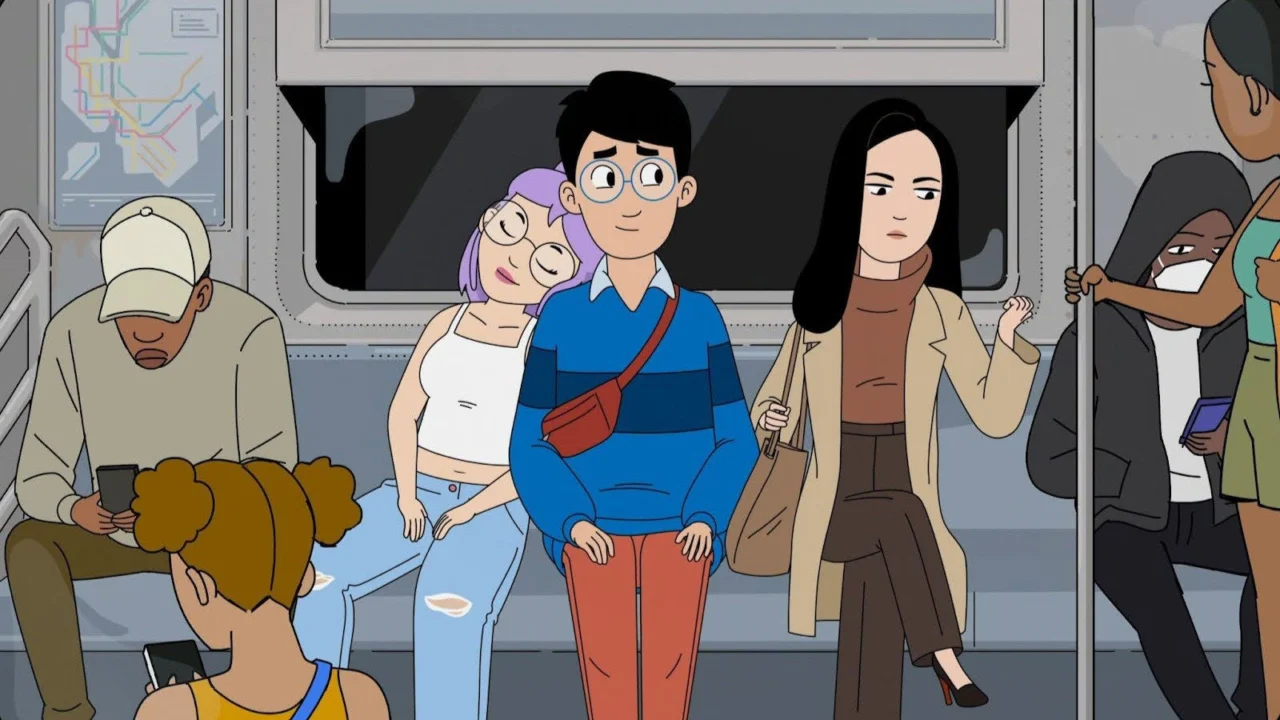
And then the bus. The Greyhound south is the first uncluttered frame all season, windows, highway, the hum of the engine replacing the screech of the PA. Eunice sleeps against Andrew’s shoulder. Ruthie stares forward, holding her phone. There is no score swelling under the final shot, just the road noise and the soft glow of a message that doesn’t say the thing it means.
That is the show’s true language: obliqueness as tenderness. The mother who could not say “I forgive you” instead asks about a catastrophe on the other side of the world as an excuse to ask if Ruthie is eating. Andrew recognized this pattern after his coming-out, when the parents’ acceptance arrived through small, non-verbal gestures rather than speeches. The text in Ruthie’s hand is that same pattern echoing. In this diaspora, love doesn’t show up with a banner. It shows up as a forwarded news story and a question about sleep.
Fan Debate: A Bridge, or a Beautifully Painted Ceiling?
The season’s open thread has divided the show’s fan communities into two camps. The optimistic read: the mother’s text mirrors Andrew’s post-coming-out arc so precisely that it has to signal eventual acceptance. The oblique route is the family’s only route, and Ruthie just got her ticket punched.
The cynical read carries weight too. Andrew is a son. Ruthie is a daughter whose illegitimate pregnancy is public, whose failure carries a different tax in immigrant families. The text might be performative damage control, a way for the mother to check a box and keep up appearances within the privacy of her own phone.
The evidence tips slightly toward the optimists, because the mother referenced a distant tragedy rather than the local one. She knows exactly what she is doing. She is testing whether Ruthie will let her in.
No Stinger, Just a Southbound Bus: What Season 2 Carries
There is no mid-credits sequence, no post-credits cameo, no money shot of Peter’s face finally appearing. The producers let the text message land and cut to black, which is the right kind of restraint for a season built on the slow dismantling of performance. But the luggage rack is full for a second season.
Ruthie’s pregnancy advances with a co-parenting arrangement still entirely off-screen, and Peter remains a name without a face, a time bomb, not a character. Eunice’s OnlyFans work has been declared but not reconciled with her parents. Andrew’s fragile hope of acceptance needs actual pressure-testing. And the mother, who has spent a lifetime perfecting her public choreography, will have to decide whether her daughter’s truth is a threat to that performance or the first honest duet she has ever been offered.
The bus keeps rolling south through the credits, carrying three siblings who have finally stopped pretending to be anything other than what they are: exhausted, exposed, and unaccountably still together. Ruthie’s thumb rests on the message a moment longer. Then she turns off the screen, presses her head against the vibrating glass, and lets the highway take her home.